
Soccer Leagues
Explore national, regional, state, and local youth soccer leagues. Browse soccer clubs by league affiliation like ECNL, MLS Next, NPL, GA and more.
Browse Soccer Clubs by League
Select a league to see participating clubs.
Elite national all girls soccer league focused on female player development
The Elite Clubs National League (ECNL) Boys is a premier national youth soccer league, established in 2017, designed to provide the highest level of competition and optimal developmental environments for male youth soccer players in the United States. It aims to enhance the player experience through a true national competitive league, improve the identification process for U.S. Youth National Teams via a systematic scouting program, and elevate daily training environments by sharing best practices among member clubs. The league features top boys clubs from around the country, typically in U13-U19 age groups, and is a primary resource for college recruitment, with national events attended by numerous college coaches.
The Elite Clubs National League (ECNL) is recognized as the highest level of youth soccer development for female athletes globally. Founded in 2009, its mission is to improve the competitive environment through a national league with multiple flights, enhance the identification process for U.S. Youth National Teams, and uplift the daily training experience at top clubs. The ECNL Girls program, which includes U13-U19 age groups, provides consistent exposure to college coaches and offers comprehensive guidance in the college recruitment process, with a high success rate in college commitments.
The Elite Clubs National League - Regional (ECNL-RL) serves as the second tier of competition under ECNL youth soccer. It is managed to ensure a consistent environment and level of professionalism, facilitating club connectivity and offering a pathway for more players to reach their potential. ECNL-RL provides high-level regional play through geographically-based divisions, minimizing travel while maintaining strong competition. Top-performing teams can advance to national events, including the ECNL Regional League Playoffs and Finals, providing broader competitive exposure and college showcasing opportunities for older age groups.
The Elite Clubs National League - Regional (ECNL-RL) Girls is the second tier of competition under ECNL, offering a high-level regional platform for youth soccer clubs. It aims to provide players with increased competition and access to a regional platform, serving as a pathway for excelling players to potentially reach national-level competition within the ECNL program. The ECNL-RL integrates with the broader ECNL structure, sometimes allowing teams to qualify for postseason play and participate in college showcases.
A leading youth development platform specifically designed for the best female soccer players in the United States. It focuses on developing female athletes holistically, both as soccer players and as individuals. A distinguishing characteristic of the Girls Academy is its emphasis on player voice; the league is "built for the players and by the players," with their perspectives helping to shape its mission and future. The GA provides a competitive environment for female players, offering league schedules, various events like the Champions Cup and Annual Summit, and opportunities for college exposure.
Major League Soccers recreational youth program dedicated to providing an inclusive and high-quality soccer experience for all. Their mission is to make soccer fun and affordable, ensuring more kids have the opportunity to play. Open to children ages 4-14, MLS GO is designed for everyone—from future pros to first-time players, with a focus on teaching fundamental skills and fostering a lifelong love of the game. Offering a structured, community-based program with connections to a developmental pathway, the program aims to break down barriers and make soccer accessible to all.
A premier youth soccer development platform created by Major League Soccer, serving as the highest level of boys youth soccer in North America. It provides an elite training and competition environment for players across various age groups, from U13 to U19, with the goal of developing future professional soccer players. The program focuses on player development through high-quality coaching, professionalized environments, and a structured pathway to professional soccer and collegiate opportunities. MLS NEXT organizes significant tournaments such as the MLS NEXT Cup and Generation adidas Cup, which showcase top talent and are key events for scouting by professional clubs and colleges.
Newly introduced in 2025, a second competitive tier within the MLS NEXT youth soccer league, designed to provide more development opportunities for aspiring players, offering a high-performance environment. Featuring more than 1,200 teams from more than 220 clubs across regional divisions, each division is managed by leading league operators across the youth landscape with a strong commitment to player development.
The National 1 League (N1) is the unified national team-based youth soccer competition platform born from the historic merger of the US Youth Soccer (USYS) National League and the US Club Soccer National Premier Leagues (NPL). As a central pillar of the U.S. Soccer "Pathway Strategy" and the "In Service to Soccer" initiative, the N1 framework leverages a unified sanctioning model under US Club Soccer to achieve administrative economies of scale, reduce geographic fragmentation, and lower participation costs. Launching for the 2026-27 seasonal year, N1 encompasses approximately 10,000 teams and 150,000 players, making it the apex team-based competition platform within the US Club Soccer and US Youth Soccer hierarchies. The league features a merit-based advancement model with promotion and relegation, integrates proven regional operators across its eight-conference geographic structure, and serves as the definitive bridge to the pre-professional segment — specifically connecting to the ECNL postseason and the ECNL Regional League. The N1 season concludes with the ECNL Conference League Playoffs, providing a unified postseason championship pathway.
A regionally organized national youth soccer platform under US Club Soccer, designed to provide high-level soccer competition and player development opportunities across the United States. The NPL features numerous member leagues that operate regionally, allowing teams to compete within their geographic areas while still being part of a national structure. The pinnacle of the NPL season is the NPL Finals, where top teams from various member leagues converge to compete for national championships. The league aims to foster player development through meaningful competition and a structured pathway, emphasizing strong club-centric environments.

The Elite Clubs National League (Pre-ECNL) is a developmental competition primarily for younger male and female players, typically in the U9-U12 age groups. It functions as a stepping stone, preparing players for future participation in the more competitive ECNL and ECNL-RL platforms. This league focuses on foundational skills, technical development, and understanding of the game through structured training and competitive play. Pre-ECNL competition prioritizes quality games with limited travel, and its format can vary by region to best suit participating clubs and player development needs.

The US Youth Soccer National League is a premier national competition platform designed to provide high-level play for youth soccer teams and clubs across the United States. It offers both team-based and club-based divisions, allowing individual teams to compete at an advanced level in various geographical areas or enabling like-minded clubs to participate in a structured league setting. The National League provides pathways into national events and postseason competition, with top-performing teams advancing to events like the National League Semifinals and ultimately vying for the annual USYS National Championships. The league emphasizes strength, stability, and structure in its competition, ensuring meaningful games and a clear progression for players.
Frequently Asked Questions
What is Club Soccer?
Club Soccer, also commonly known as travel soccer, represents a higher level of competitive youth soccer compared to recreational leagues. In the club system, players typically attend tryouts to be selected for a team within a privately-owned soccer club. These clubs are focused on long-term player development and compete against other clubs in various leagues and tournaments. The environment is more structured, with professionally licensed coaches, more frequent practices, and a greater time and financial commitment. The goal is to develop players' technical skills, tactical understanding, and overall passion for the game at a more intensive level.
If you're interested in exploring this path for your child, a great first step is to see what options are available in your area. You can start by looking at our directory of youth soccer clubs. For a deeper dive into what this journey entails, check out our article on Understanding Youth Soccer Player Development.
What is the difference between travel, club, and rec soccer?
Club Soccer and Travel Soccer are generally synonymous terms for competitive soccer programs. They are a significant step up from recreational soccer in terms of commitment, competition, and cost.
Here’s a breakdown of the key differences:
- Competition Level: Club/Travel soccer is highly competitive, with teams formed through tryouts. Recreational (Rec) soccer is open to everyone regardless of skill level, focusing on fun and participation.
- Coaching: Club teams are typically coached by licensed, professional coaches who are paid for their services. Rec teams are often coached by parent volunteers.
- Commitment: Club players commit to a full soccer year (fall and spring seasons) and are expected to attend multiple practices per week (often 2-3 sessions of 90-120 minutes) and games on weekends. Rec soccer usually involves a shorter season, with maybe one practice and one game per week.
- Travel: As the name implies, travel/club soccer involves traveling to play games against teams from other towns, cities, or even states, especially for tournaments and showcase events. Rec soccer games are almost always local.
- Cost: The financial commitment for club soccer is significantly higher, covering professional coaching, league fees, tournament entries, and uniforms. You can learn more in our detailed guide on the Cost of Youth Soccer.
- Player Development: The primary focus of club soccer is on developing individual skills and tactical knowledge to prepare players for higher levels of competition. Rec soccer focuses more on learning the basic rules, sportsmanship, and having fun.
For families looking for a fun, introductory experience, a recreational program like MLS Go can be a perfect start.
What are the different youth soccer leagues in the US?
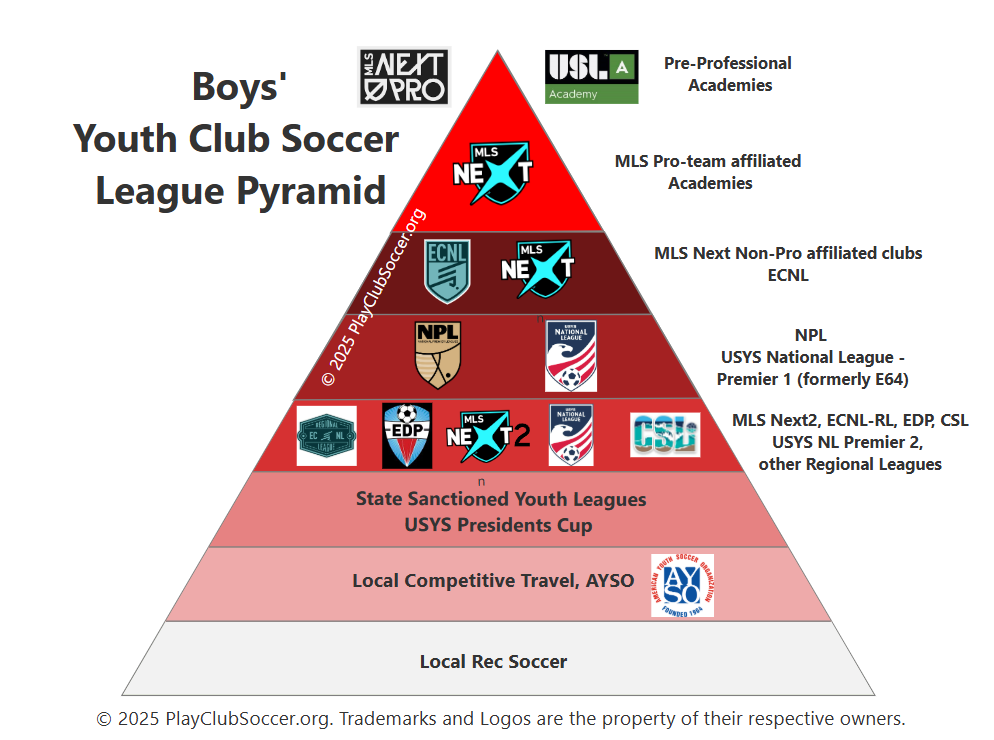
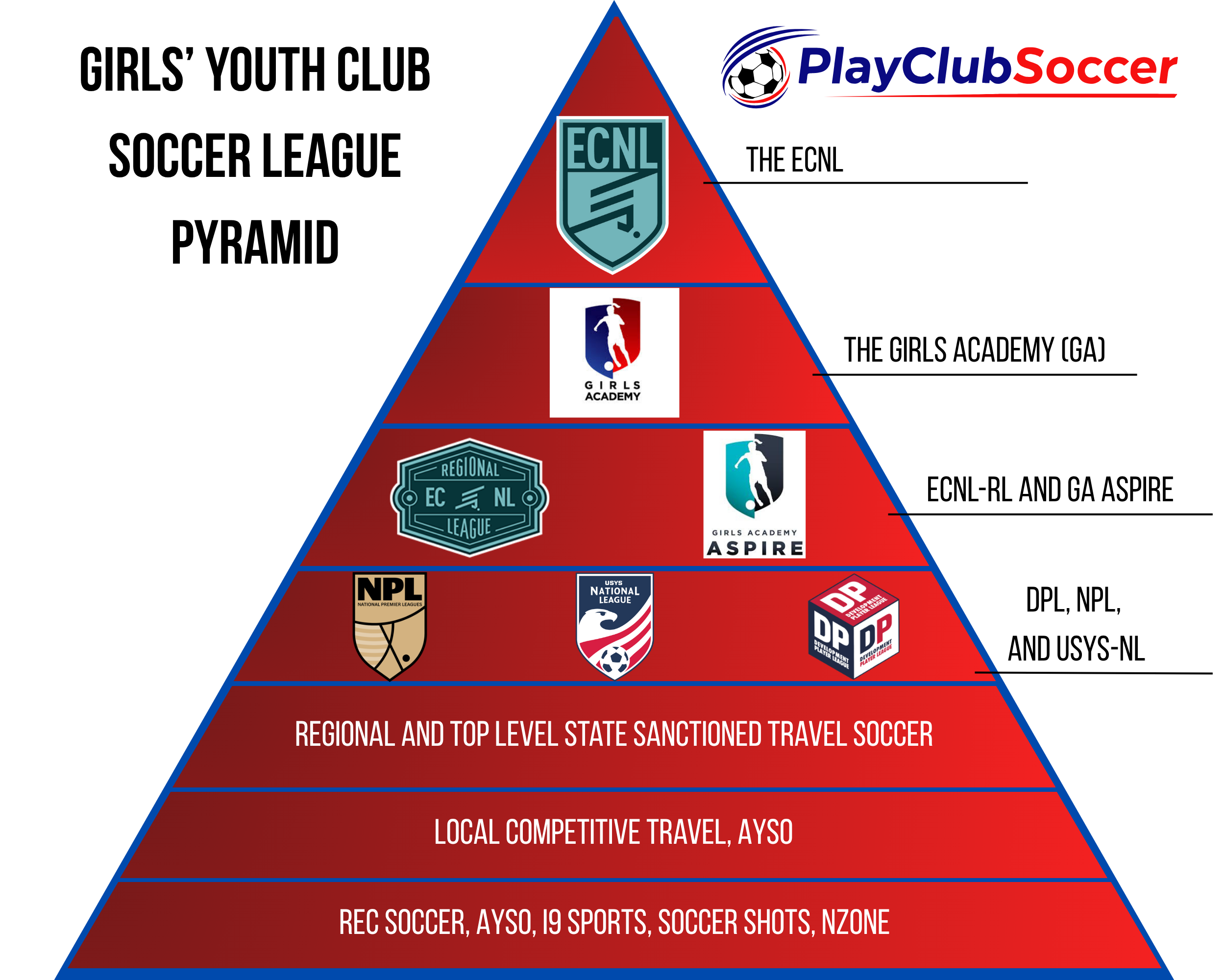
The U.S. youth soccer landscape is comprised of numerous leagues, each offering different levels of competition, exposure to college scouts, and geographical reach. Understanding this structure can be complex, but it can generally be viewed as a pyramid.
Here are some of the most prominent national and regional leagues:
- MLS NEXT: Considered the highest level of boys' youth soccer in North America, it's run by Major League Soccer and focuses on developing players for professional and national teams. Learn more about the new two-tiered system in our Guide to the New MLS Next Divisions.
- ECNL (Elite Clubs National League): The ECNL is a premier national league for both boys and girls, known for its high level of competition and as a major platform for college recruitment. It includes both national and regional tiers (ECNL-RL).
- Girls Academy (GA): A top-tier, girls-only league created by and for players, focusing on holistic player development and providing a direct pathway to college and national teams.
- US Youth Soccer National League: One of the largest and most established leagues, offering a tiered structure with both team-based and club-based competition that provides a pathway to the annual USYS National Championships.
- National Premier Leagues (NPL): A national competition platform by US Club Soccer that consists of various regional member leagues, culminating in a national championship event.
For a comprehensive overview of how these leagues compare, explore our Youth Soccer Leagues guide and our detailed analysis in the Boys Youth Soccer Pyramid Explained.
How do I choose the right club for my child?
Choosing the right soccer club is a crucial decision that can shape your child's athletic and personal development. It's about finding the best fit for their skills, goals, and personality, as well as what works for your family.
Here are key factors to consider:
- Club Philosophy and Culture: Does the club prioritize winning at all costs, or is there a strong emphasis on player development, sportsmanship, and fun? Try to observe a practice or game to get a feel for the environment.
- Coaching Quality: Look for experienced, licensed coaches who are good teachers and positive role models. A good coach knows how to motivate and develop young athletes while fostering a love for the game.
- Player Development Pathway: Does the club have a clear plan for developing players from younger ages to older, more competitive levels? What opportunities do they provide for growth?
- Level of Competition: Ensure the club competes at a level that will challenge your child without being overwhelming. This is where understanding the different youth soccer leagues is important.
- Logistics and Cost: Consider the practice schedules, travel requirements, and overall financial commitment. Be sure to understand what is included in the club fees and what will be extra.
To begin your research, you can browse our directory of youth soccer clubs. For more tips on the evaluation process, read our guide on Understanding Youth Soccer Player Development.
What is the pathway to college soccer?
Navigating the college soccer recruiting process requires a proactive and organized approach from both the player and their family. The journey typically begins in the early high school years.
Here are the essential steps on the pathway to playing college soccer:
- Play at a High Level: Competing in nationally recognized leagues like ECNL, Girls Academy, or MLS NEXT is crucial for exposure, as college coaches heavily recruit from these platforms.
- Maintain Strong Academics: Good grades and standardized test scores are non-negotiable. Student-athletes must meet NCAA eligibility requirements to be considered.
- Create a Player Profile & Highlight Video: Compile a soccer resume that includes your academic achievements, athletic accomplishments, and contact information. A well-edited highlight video (3-5 minutes) is essential to showcase your skills to coaches.
- Attend ID Camps and Showcases: These events are specifically designed for prospective student-athletes to demonstrate their abilities in front of numerous college coaches.
- Proactive Communication: Don't wait to be discovered. Research schools that are a good fit both athletically and academically. Send introductory emails to coaches, including your player profile and highlight video, and follow up persistently.
- Guidance from Your Club: Your club coaches and directors can be valuable resources in connecting with college programs and offering advice.
For a complete breakdown of the timeline and strategy, be sure to read our Youth Soccer Guide to College Soccer Recruiting.