The U.S. Girls Youth Soccer Pyramid: A Parent's Guide to League Tiers in 2025/2026
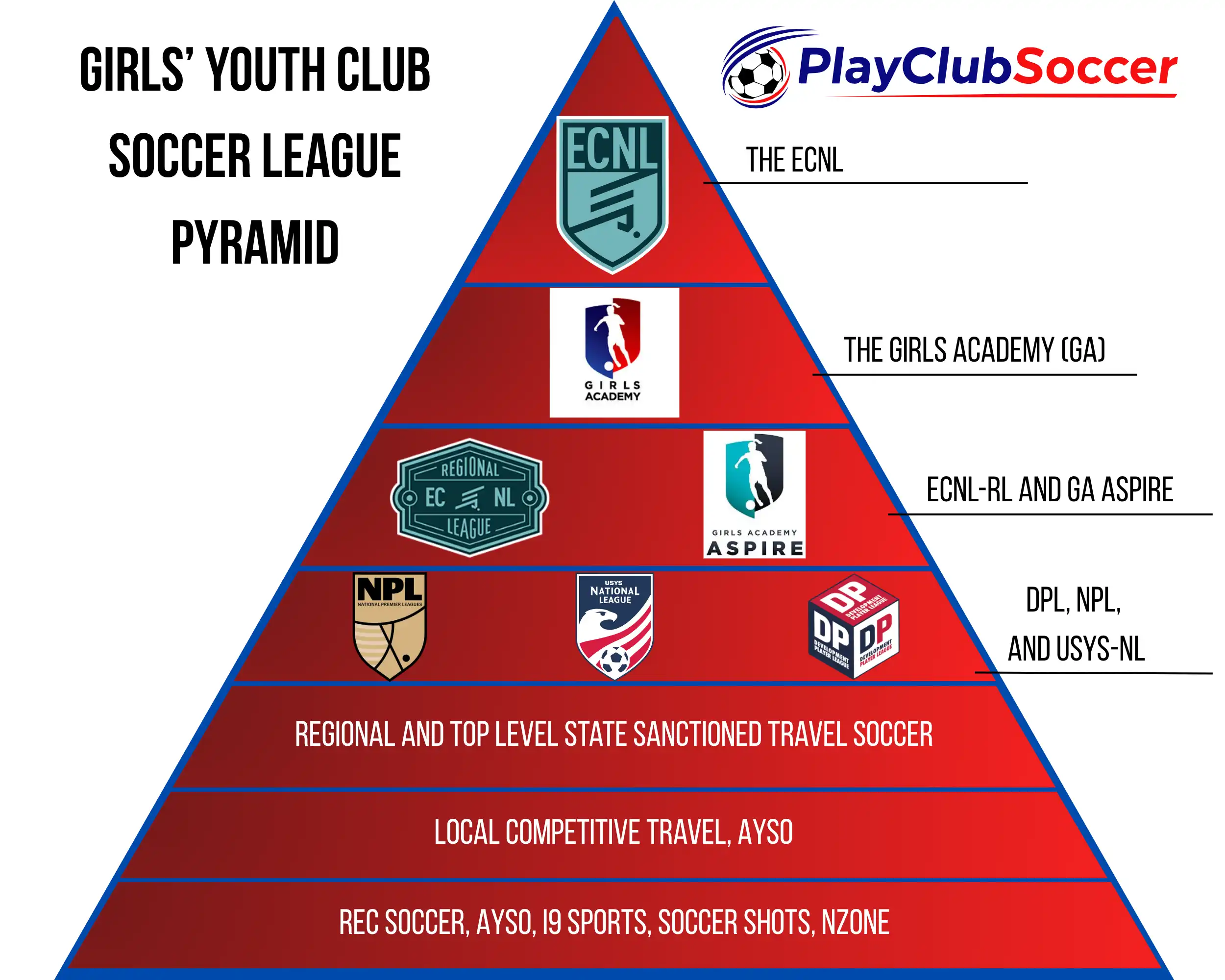
The U.S. Girls Youth Soccer Pyramid: A Parent's Guide to the Tier List
Trying to figure out the Girls Youth Soccer Pyramid in 2025? You're not alone. With leagues claiming to be "elite" and "premier" at every turn, it can be confusing and overwhelming to understand what league or team is the "Best" or what the best fit is for you and your family. As a soccer parent and coach, I've been down the same road and hope to help guide others with this informational (un-official) tier list. Just like the boys' youth soccer pyramid, the girls' is a bit messy too. Leagues can overlap, have their own "tiers" within their overarching platform, and have affliliations with other leagues. The "best" team in a lower tier can sometimes beat a team in a higher one, and clubs have teams scattered across different leagues. Why even use a pyramid then? Well, as confusing as it is, there is still a general funnel to the soccer landscape that attempts to filter the most talented and gifted players and teams to the top competition. It's just not always clear from the outside where everything fits. This guide is here to break it down for you, as simple as possible.
Key Takeaways
- Tier 1: ECNL - Generally seen as the top girls soccer league with the best national competition and college exposure.
- Tier 2: Girls Academy (GA) - A close second, formed more recently and has an alliance with MLS NEXT.
- Tier 3: ECNL-RL & GA Aspire - These are the regional feeder leagues for the top two. A solid place for highly competitive development.
- Tier 4: DPL, NPL, USYS-NL - A mixed bag of regionalized national platforms. The level of play here can really vary depending on your region, but still very competitive.
- Tiers 5-6: Regional, State, Travel - These tiers range from competitive regional and state play to local travel soccer.
- Tier 7: Local Recreational Soccer - Soccer's foundatation where everyone gets to play.
What's the Real Difference between ECNL, GA, Aspire, DPL, NPL, USYS NL ...?
Trying to understand the girls' youth soccer structure can be a headache. Every league and club markets itself as the best "pathway" for your daughter. But a pathway to what, exactly? "Pathway" is the way clubs market their club's path to college scholarships, the pros, perhaps even the United States National Teams or whatever they deem is the top team or league in their offerings. For parents, its about finding the right level of competition where your kid can succeed and grow.
As mentioned already, the pyramid is somewhat subjective. A top team from a Tier 4 league could very well beat a mid-level team from a Tier 3 league. My daughter's team played in a regional league and we've had some surprising wins against so-called "elite" national teams in tournaments. It really comes down to the quality of the specific club and the team itself, not just the league patch on their sleeve. So, dont get too caught up in the labels. A club might have its 'A' team in the ECNL and its 'C' team in the NPL, while another club's 'A' is in the NPL and 'B' team is a state travel team. It's all about finding the right fit for your player's skill and commitment level and also finding the right coach.
Tier 1: The ECNL
The ECNL (Elite Clubs National League) is generally considered the top platform in girls' youth soccer. Founded back in 2009, it has the largest national footprint and hosts national showcase events that are attended by college scouts for recruiting. If your daughter has serious aspirations of playing high-level college soccer, the ECNL is the place to be.
The competition is fierce, and the travel commitment is no joke. You're playing against the best from all over the country. It's a significant investment of time and money, but for players aiming for the top, it offers an unparalleled platform for college soccer recruiting. ECNL has separate girls and boys platforms in the U13 to U18/U19 age groups.
Tier 2: The Girls Academy (GA)

Formed in 2020 after the U.S. Soccer Development Academy (DA) folded, the Girls Academy (GA) has quickly established itself as a major player. Many of the former top DA clubs banded together to create the GA, and it has become the main competitor to the ECNL. The GA has a strategic alliance with MLS NEXT, which is the top boys' league. This partnership is helping to raise the GA's profile and provides access to top-notch resources and events, like the Generation Adidas Cup. The GA, Aspire, and DPL form their own Girls Soccer Pyramid, with GA at the apex, then Aspire and DPL functioning as the development programs.
The GA, along with its sister leagues, prides itself on a holistic approach to player development, focusing on the person as well as the player. They have a player-led advisory panel, which I think is a fantastic idea. It gives the girls a voice in their own league. From what I've seen, the level of play is extremely high, and they attract a lot of attention from college coaches as well. The ECNL and GA provide two very strong national platforms for elite female players. The GA is for girls only, primarily in the U13-U19 age groups.
Tier 3: ECNL-RL and GA Aspire
Think of this tier as the feeder to the top programs. The ECNL Regional League (ECNL-RL) is the second tier under the main ECNL. It's designed for clubs and players who are aspiring to play at the highest level. The competition is still very strong, but the travel is more regionalized, which can be a plus for many families. The best teams in the ECNL-RL can earn promotion into the national ECNL, so there's a clear incentive to perform. We've seen some fantastic talent come out of the RL, and it's a great place for players to develop against quality opponents without the full coast-to-coast travel schedule.
Similarly, the Girls Academy has its own second tier called GA Aspire. Launched in early 2025, Aspire serves as a bridge for players and clubs looking to make the jump to the top GA platform. It operates on a merit-based system, ensuring that the level of competition is high and that teams are rewarded for their performance. It provides a structured pathway for development and offers exposure at regional and national showcases. For many, these Tier 3 leagues are the sweet spot, offering a great balance of high-level competition and manageable logistics.
Tier 4: DPL, NPL, and USYS-NL

Welcome to the murkiest level of the pyramid. Here you'll find a few different leagues that all operate on a national scale but with a lot of regional variation. The quality of play in this tier can be all over the place. A top team in the DPL (Development Player League) in one part of the country might be much stronger than a team in another region. The DPL's mission is to develop the player in a purposeful environment, and it serves as a feeder league for the Girls Academy. It's a girls-only league for the U13-U19 age groups.
The NPL (National Premier Leagues) and the USYS National League are both run by major youth soccer governing bodies. The NPL, managed by US Club Soccer, is a collection of regional leagues where the winners advance to a national championship. The USYS National League has a similar structure, with teams competing in conferences to earn a spot in national events and a shot at the USYS National Championships. These leagues can be a great option for competitive teams that may not be in an ECNL or GA club, providing a platform to compete against strong regional opponents.
Tier 5: Other Regional and Top Level State Sanctioned Travel Soccer
This is where you find a whole host of strong regional and state-sanctioned leagues. Leagues like EDP (Elite Development Program) on the East Coast or CSL (Coast Soccer League) in Southern California are big players in their respective areas. These leagues are the backbone of competitive soccer for thousands of players. They offer a high level of play, often with less travel and cost than the national platforms.
Most states also have their own sanctioned leagues, often run by US Youth Soccer. These state leagues are usually broken down into multiple divisions (like Premier I, Premier II, III, etc.), allowing teams to find an appropriate level of competition. For many teams at this level, the big goal is to win their state cup and advance to the USYS Presidents Cup, which is a national championship competition for state-level teams. The passion and desire to win a State Cup can be just as intense as any national final. It may not be the top, but it's all the same serious, competitive soccer.
Tier 6: Local Competitive Travel, AYSO
Local competitive travel soccer is where many players get their first taste of a more serious soccer environment. It often involves tryouts and playing against other town or small local clubs. Organizations like AYSO (American Youth Soccer Organization) and local rec departments usually offer a team in each age group that is more competitive than pure recreational.
Tier 7: Rec Soccer, AYSO, i9 Sports, Soccer Shots and others
Recreational soccer is all about having fun, learning the basics, and fostering a love for the game. Many communities have local recreation departments that organize rec teams coached by volunteer parents (like I was for my daughter's first team). There are also a number of franchise oragnizations like i9 Sports, Soccer Shots, NZone and others that organize teams and games to compete in a fun environment, usually at the same field each week. The costs are minimal, and everyone gets to play. These grassroots programs are incredibly important. Without them, there would be no top of the pyramid. This is where the journey starts for a lot of players.

Note about the Pre-Professional Ranks - USL Academy and USL W
You might also hear about leagues like the USL Academy and the USL W League. These are more like pre-professional leagues and competition, sitting just outside this youth soccer tier list. They are typically for older age groups, around U20, and serve as a direct link to senior professional teams. The USL Academy provides a platform for elite youth players to train and compete in a professional environment, often serving as a reserve team for clubs in the pro USL leagues.
The USL W League is a pre-professional women's league that gives top college players and elite youth players a place to compete at a high level during the summer. Some of the very top U18 or U19 players might get a chance to "play up" with these teams, which is an amazing experience and a great step on the pathway to a professional career. So, while they aren't part of this youth club pyramid, they are a key part of the overall player development landscape in the U.S.

Frequently Asked Questions (FAQs)
Q: Can a team from a lower tier beat a team from a higher tier? A: Absolutely. It happens all the time in tournaments. The pyramid is more of a general guide to the level of competition. A strong, well-coached team from a regional league can definitely beat a team from a national league on any given day.
Q: What's the main difference between the Girls Youth Soccer Pyramid and the boys' pyramid? A: The top of the pyramid is different. The boys have MLS NEXT as the highest level, which is run by Major League Soccer. For girls, the top is a competition between the ECNL and the Girls Academy, two independent leagues.
Q: How do I know which league is the best fit for my daughter? A: Look beyond the league label. Consider the specific club's coaching quality, their philosophy on player development, the travel commitment, and the cost. The "best" league is the one where your daughter will be challenged, supported, and enjoys playing.
Q: Can a player move between these leagues? A: Yes. Players switch clubs and leagues all the time. Many leagues, like the ECNL-RL and DPL, are designed as feeder systems, with top players getting opportunities to move up to their club's higher-level teams.
Q: What are the costs associated with each tier? A: The costs increase as you go up the pyramid. Recreational soccer is the most affordable, while the top national leagues like ECNL and GA involve significant expenses for club fees, travel, uniforms, and showcase events.
Q: With the youth soccer age group change in 2026, how will that affect these leagues? A: All the leagues will have to adjust to the new birth-year registration mandates. This will cause some shifts in team rosters and dynamics across the board as they realign their age groups, but the overall structure of the pyramid should remain the same.