Youth Soccer Pyramid Explained: A Tier List of the Best Boys Leagues in the USA in 2025
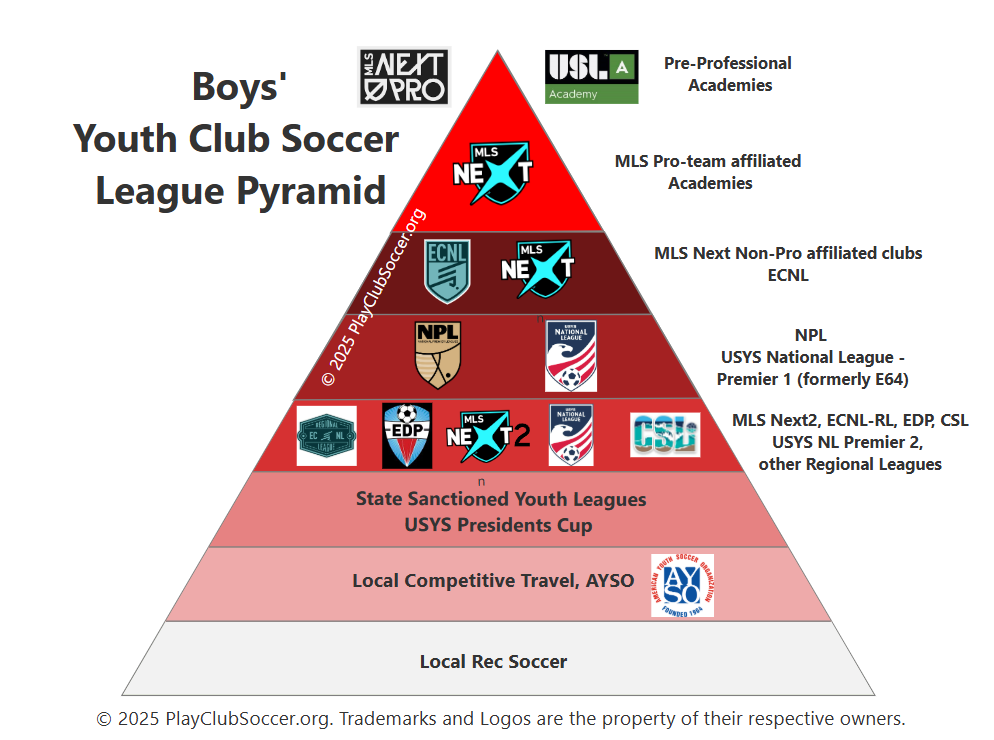
What's the difference between MLS NEXT, ECNL, NPL, USYS NL ...?
With a dizzying array of acronyms, overlapping leagues, and varying levels of competition, the youth soccer system in the U.S is a bit of a mess. This guide is our attempt to untangle the complex U.S. Boys Youth Soccer Pyramid in 2025.
For our take on the Girls' Youth Soccer Pyramid, Go HERE. The U.S. Girls Youth Soccer Pyramid: A Parent's Guide to League Tiers in 2025/2026
If you've ever found yourself asking, "What's the real difference between all these leagues?" while researching the best soccer clubs near you, you are not alone. MLS NEXT, ECNL, NPL, USYS, NL, EDP, EAL, NAL. They all claim to be "elite," "premier," and the definitive "pathway." But a pathway to what, exactly? They claim to be the best path for your son's development. The reality is, the "best" path is the one that's right for your child's individual goals, abilities, and your family's commitment, time and money. Adding to the complexity, clubs affiliate with multiple leagues and field several teams per age group (e.g., A, B, and C teams) that play in different leagues, so when searching for and trying out for clubs be sure to ask the coaches what team your son will be placed on and what league that specific team competes in.
The best league is often subjective and highly dependent on your region, the specific club, and the team itself. The pyramid is often blurry, with overlapping levels of competition where the best teams from a lower tier can compete with teams from a supposedly higher ones, so don't take this as 100% definitive and call me an idiot because your kids NPL squad is so much better than that MLS Next team across town. A well-coached, highly-motivated team in a lower-tier league can absolutely outperform a team in a higher-tier league.
The landscape is constantly evolving. MLS Next 2 (or MLS Next New Competion Tier - I'm not sure if they've settled on a name) could overtake established top tier leagues in the coming years, but we'll talk more about that soon.
Youth Soccer Age Group Change
Another major upheaval, starting in the 2026-2027 season, major governing bodies, US Youth Soccer, US Club Soccer and AYSO will be moving from a birth-year (January 1 - December 31) to a school-year based system (August 1 - July 31) for team formation. MLS Next as of now is sticking with birth year.| Soccer Club | Affected by Age Group Shift? | When? |
|---|---|---|
| MLS NEXT | No | - |
| MLS Next2 | No | - |
| ECNL | Yes | Fall 2026 |
| ECNL-RL | Yes | Fall 2026 |
| NPL | Yes | Fall 2026 |
| USYS NL | Yes | Fall 2026 |
| AYSO | Yes | Fall 2026 |
The U.S. Boys Youth Soccer Pyramid: Tiered Breakdown
TIER 1
MLS NEXT (Professional MLS Academies)
At the very apex of the pyramid I'm putting, alone, the academies directly affiliated with Major League Soccer's (MLS) professional teams. There are 30 MLS Academies, and they have the most resources, best coaches, and best facilites in the U.S. There are other clubs and academies in the U.S. that have amazing coaches and facilities, but it's tough to compete with the prestige of a professional soccer team. The most selective and by far hardest for a soccer player to make, these academies are the most direct pathway to a professional soccer career in North America. MLS and the United States National Teams are the highest level of soccer in the United States, and these are the programs that identify and develop the next generation of professional and national soccer players. Formed by many of the elite clubs from the former U.S. Development Academy (DA) along with the MLS Academies, MLS NEXT effectively replaced the DA when it shuttered in 2020. The USMNT actively scouts and receives player recommendations from the MLS NEXT Academies. All of the MLS-affiliated academies are fully funded, meaning there is little to no cost for the players selected. MLS NEXT academies are a year round commitment and do not allow players to compete on high school teams.
- Pathway: The primary goal is to develop players for the club's professional first team. Talented players can progress from the academy to MLS Next Pro and then to the MLS senior roster. Elite players also go on to play in Europe and USMNT.
- Age Groups: U13, U14, U15, U16, U17, and U19.
- Boys Only: Yes.
For more information and to find MLS NEXT clubs near you, visit the MLS NEXT league page.
TIER 2
Non-MLS Affiliated MLS NEXT Clubs & ECNL (Elite Clubs National League)
Just below the professional academies are the non-MLS affiliated MLS NEXT clubs and the top teams in the ECNL. Clubs in this tier are hotbeds for NCAA Division 1 college recruitment. While MLS NEXT is generally considered the most prestigious for boys, the ECNL is also a highly respected and competitive national league. In some regions, the top ECNL clubs can be just as strong, if not stronger, than some MLS NEXT clubs. It's also worth noting that clubs generally cannot have both a boys' MLS NEXT and a boys' ECNL team, forcing them to choose a platform. The decision between MLS NEXT and ECNL for college-bound players can be nuanced. MLS NEXT showcases often attract a high number of college coaches, but ECNL's national events are also premier recruiting opportunities. A significant factor for many families is that top-tier MLS NEXT programs may restrict or prohibit players from participating in high school soccer, while the ECNL allows for it.
- Pathway: Develop the most talented players for high level collegiate and pre-professional soccer programs
- Non-Pro affiliated MLS NEXT: These are elite academies that are not directly affiliated with an MLS team but have been accepted into the MLS NEXT platform based on their quality and standards. The competition level is extremely high, and these clubs often produce numerous collegiate players.
- ECNL: The Elite Clubs National League (ECNL) is a national league known for its high level of competition and excellent college showcase events.
- Age Groups: U13, U14, U15, U16, U17, and U19. ECNL clubs also often offer Pre-ECNL teams for younger ages.
- Boys Only: The ECNL has both boys' and girls' leagues, but they are separate entities. MLS NEXT is boys only.
For more information and to find ECNL clubs near you,, visit the ECNL Boys league page.
TIER 3
NPL (National Premier Leagues) & US Youth Soccer National League - Club Premier 1

This is where the pyramid starts to get a bit "murky" and not to mention confusing with both of these leagues having 'National' 'Premier' and 'League' in their names. Tier 3 leagues offer a high level of competition, but the quality can vary more significantly depending on the region and the specific clubs involved. These leagues essentially are collections of regional leagues and teams across the country.
- Pathway: Compete in high level national soccer events and develop talented players for collegiate soccer programs
- NPL (National Premier Leagues): Sanctioned and managed by US Club Soccer, the NPL is a national platform of regional leagues. The champions of these regional NPLs advance to the NPL Finals. The NPL provides a competitive environment with a focus on player development and a more manageable travel schedule than the top national leagues.
- NPL member leagues:
- Central States NPL
- Florida Club Leagues (FCL)
- Frontier Premier League
- Great Lakes Alliance
- Gulf States Premier League
- Mid-Atlantic Premier League
- Midwest Development Leage (MDL)
- Minnesota NPL
- Mountain West NPL
- Northern Illinois Soccer League (NISL)
- NorCal Premier
- Red River NPL
- SOCAL NPL
- South Atlantic Premier League
- South Texas Champions League (STXCL)
- Texas Club Soccer League (TCSL)
- Virginia Premier Soccer League (VPSL)
- Washington Premier League (WPL)
- USYS National League (NL) Club Premier 1 (formerly E64): This is the top level of competition under the US Youth Soccer umbrella. The USYS National League is a bit complex. It is comprised of two league formats each with two levels; club-based and team-based leagues, with Premier 1 (formerly E64) and Premier 2 (formerly E64 Regional) levels. Club-based is a league structure allowing entire clubs to participate in all six age groups — 13U through 19U. Clubs are held to league wide facilities and competitiveness standards. Team-based is a structure where individual teams from across the country can apply and qualify to be accepted into the team-based Premier 1 or 2 league. Top finishing teams from Premier 2 can be promoted to Premier 1. Teams earn their way into the National League through success in their respective state or regional USYS sanctioned confrences or leagues. The ultimate goal for teams in the USYS National League is to qualify for the USYS National Championships; US Youth Soccer’s premier year-long competition with state, regional and national level stages.
- USYS NL Club Premier 1 Divisions:
- Frontier (Texas)
- Great Lakes (Pennsylvania, Indiana, Ohio)
- Midwest (Illinois, Michigan, Wisconsin)
- Northeast (New York, New Jersey)
- Pacific (California, Arizona)
- Sunshine (Florida)
- Age Groups: U13, U14, U15, U16, U17, and U19.
- Boys Only: NPL and the USYS National League have both boys and girls leagues
For more information and to find USYS-NL and NPL clubs near you, visit the USYS National League page and the NPL league page.
TIER 4
MLS Next2, ECNL-RL, EDP, CSL, USYS-NL Premier 2, & Other Regional Leagues

Welcome to the most varied and often confusing tier of the pyramid. The level of play in these leagues can range dramatically, from teams that could compete in Tier 3 to those that are a clear step below.
- Pathway: Teams competing in this tier can be highly competitive and offer a path to the stand out players to move up to their respective higher tier teams and leagues.
- MLS Next2: New for the 2025 season, MLS Next2 is a second tier under the MLS NEXT umbrella. It has incorporated 5 existing leagues as new divisions. While the overall competition level will be wide-ranging, which is why I put it in tier 4, the top teams in MLS Next2 are expected to be on par with NPL and even some ECNL clubs. This new MLS NEXT tier aims to develop players with the same technical and training standards as the top tier and will also provide a pathway for more players to be seen by MLS NEXT scouts. MLS Next2 is a big shake up for youth soccer, as many clubs see the access to the MLS brand as desirable, and they may change affliliations for their top clubs in the future.
- MLS Next2 member leagues:
- National Academy League (NAL)
- Elite Academy League (EAL)
- Sporting Development League (SDL)
- Cobalt Sports
- Cal North Soccer Association
- ECNL-RL (ECNL Regional League): As the name suggests, this is the regional league platform for the ECNL. ECNL-RL (or ECRL) was created to serve as a feeder system for the ECNL, providing a proving ground for players and clubs aspiring to the top tier with a reduced travel commitment compared to the national ECNL. ECNL-RL teams also have access to compete in ECNL showcase events.
- EDP (Elite Development Program): EDP organizes multiple levels of soccer, including a Premier level under the USYS NL umbrella and it's own prominent league on the East Coast.
- CSL (Coast Soccer League): One of the largest and oldest youth soccer leagues in Southern California, CSL has a tiered system with promotion and relegation, offering a pathway for teams to compete at a high level.
- USYS National League - Premier 2 (formerly E64 Regional):This is the second level under the USYS-NL.
- Age Groups: U13, U14, U15, U16, U17, and U19.
- Boys Only: MLS Next2 is boys only, the rest have both boys and girls leagues.
For more information and to find MLS Next2, ECNL-RL clubs near you, visit the MLS Next 2 league page and the ECNL-RL Boys league page.
TIER 5
State Sanctioned Youth Leagues
Every state has a sanctioned youth soccer association that operates its own leagues with multiple divisions and levels of play. These leagues provide a competitive environment for a broad range of teams and offer a pathway to the USYS Presidents Cup, a national championship competition.
- Age Groups: All age groups.
- Boys Only: No
TIER 6
Local Competitive Travel & AYSO
This tier represents a step up from purely recreational soccer, with a greater emphasis on player development and competition.
- Local Competitive Travel: These are often town- or community-based clubs that compete against other nearby towns. The focus is on providing a more structured and competitive environment than recreational soccer.
- AYSO (American Youth Soccer Organization): While primarily known for its recreational programs, AYSO also offers more competitive "All-Star" and "Select" programs for players seeking a higher level of play.
- Age Groups: All age groups.
- Boys Only: No
TIER 7
Tier 7: Local Recreational Soccer
This is the foundation of the youth soccer pyramid. Run by local clubs and organizations, recreational soccer is all about participation, fun, and learning the fundamentals of the game. It's often volunteer-coached and has minimal costs, making it accessible to all.
- Age Groups: All age groups.
- Boys Only: No
A Note on Pre-Professional Leagues: MLS Next Pro & USL Academy League
It's important to mention two leagues that sit just outside this youth soccer pyramid: MLS Next Pro and the USL Academy League. These are considered pre-professional leagues designed for older, elite players who are on the cusp of a professional career.
- MLS Next Pro: This is a professional league that essentially serves as a reserve league for MLS clubs. It provides a crucial bridge for players transitioning from the academy level to the first team.
- USL Academy League: This league provides a pre-professional environment for players age U20 within the United Soccer League (USL) ecosystem. It allows top youth players to train and compete at a high level while maintaining their college eligibility.
Finding the Right Fit for Your Soccer Player
Navigating this complex pyramid can be daunting. The key is to look beyond the league labels and focus on what truly matters for your player's development and enjoyment of the game. Here are a few things to consider when searching for the 'Best Soccer Clubs' for your player:
- Coaching Quality: A knowledgeable and supportive coach is arguably the most important factor in a young player's development.
- Club Philosophy: Does the club prioritize winning at all costs, or is there a genuine focus on long-term player development and fostering a love for the game?
- Team Environment: Observe a practice or a game to get a feel for the team's culture and how the players interact with each other and the coach.
- Your Child's Goals: Is your son dreaming of a professional career, or does he simply want to play at a competitive level with his friends? Be honest about his aspirations and find a club and league that align with them.
Ultimately, the best youth soccer experience is one where your child is challenged, supported, and, most importantly, having fun. Use this guide as a starting point, do your research, and trust your instincts as a parent. The right path is out there.